
Corporate Secretarial Services
A Private Limited Company by Shares (abbreviated as Sdn. Bhd.) is the most commonly chosen business structure in Malaysia. As a separate legal entity, it can own assets, enter contracts, and operate independently of the personal affairs of its shareholders. The shareholders’ financial exposure is limited solely to the amount they have committed through their shares, ensuring their personal assets remain protected from the company’s liabilities.
Incorporation process for a Private Company
The incorporation of a Sdn. Bhd. in Malaysia follows a structured sequence overseen by the Companies Commission of Malaysia (SSM). The process typically involves the following key stages:
1. Name Search and Reservation
An application is submitted to SSM to verify the availability of the proposed company name. Once approved, the name is reserved for use in the incorporation documents. This step ensures that the chosen name is compliant and exclusively allocated to the applicant during the reservation period.
2. Preparation of Incorporation Documents
Following name approval, all required statutory documents are prepared. These generally include details of the company’s shareholders, directors, registered office, share structure, and any applicable constitution. The documents must be completed in accordance with the Companies Act 2016.
3. Submission to SSM
The signed incorporation documents, together with the prescribed fees, are submitted to SSM for processing. Accuracy and completeness at this stage help to avoid delays in approval.
4. Issuance of Notice of Registration
Upon successful review, SSM issues the Notice of Registration, marking the official incorporation of the company. From this date, the Sdn. Bhd. is legally recognised and permitted to commence business operations.
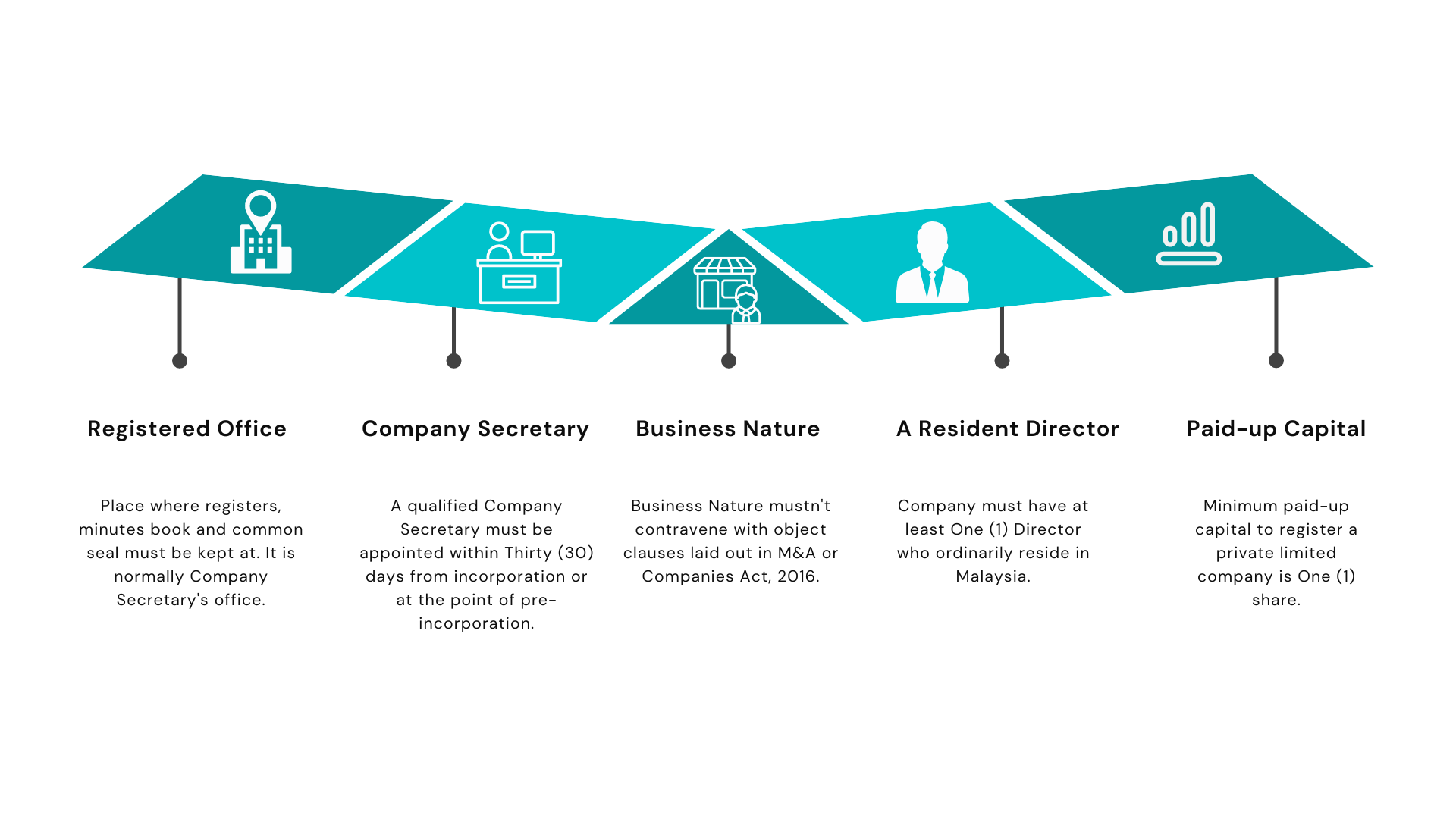
What you need to set up a Private Company
Annual Obligations of Private Company
1. Annual Return
The company must submit its annual return within 30 days from each anniversary of its incorporation date.
2. Financial Statements and Reports
The company’s financial statements and related reports must be circulated to shareholders and auditors within six months from the financial year ended, and it must be lodged with CCM via MBRS portal within 30 days from the date of circulation.
3. Beneficial Ownership Reporting
The company is required to submit the latest beneficial ownership details together with its annual return, ensuring any updates are filed beforehand.
4. Annual Tax Return
Form C & R must be filed within seven months following the end of the financial year.
5. Form E
Employers must file Form E by 31 March each calendar year, declaring employee information – even if company has not hired employees.
Incorporation process for a Public Company
The incorporation of a Bhd. in Malaysia follows a structured sequence overseen by the Companies Commission of Malaysia (SSM). The process typically involves the following key stages:
1. Name Search and Reservation
An application is submitted to SSM to verify the availability of the proposed company name. Once approved, the name is reserved for use in the incorporation documents. This step ensures that the chosen name is compliant and exclusively allocated to the applicant during the reservation period.
2. Preparation of Incorporation Documents
Following name approval, all required statutory documents are prepared. These generally include details of the company’s shareholders, directors, registered office, share structure, and any applicable constitution. The documents must be completed in accordance with the Companies Act 2016. A Prospectus is required to be lodged with SSM if the company intends to offer shares to the public. Statement in lieu of Prospectus (required if the company has not issued a prospectus inviting the public to subscribe for its shares).
3. Submission to SSM
The signed incorporation documents, together with the prescribed fees, are submitted to SSM for processing. Accuracy and completeness at this stage help to avoid delays in approval.
4. Issuance of Notice of Registration
Upon successful review, SSM issues the Notice of Registration, marking the official incorporation of the company.
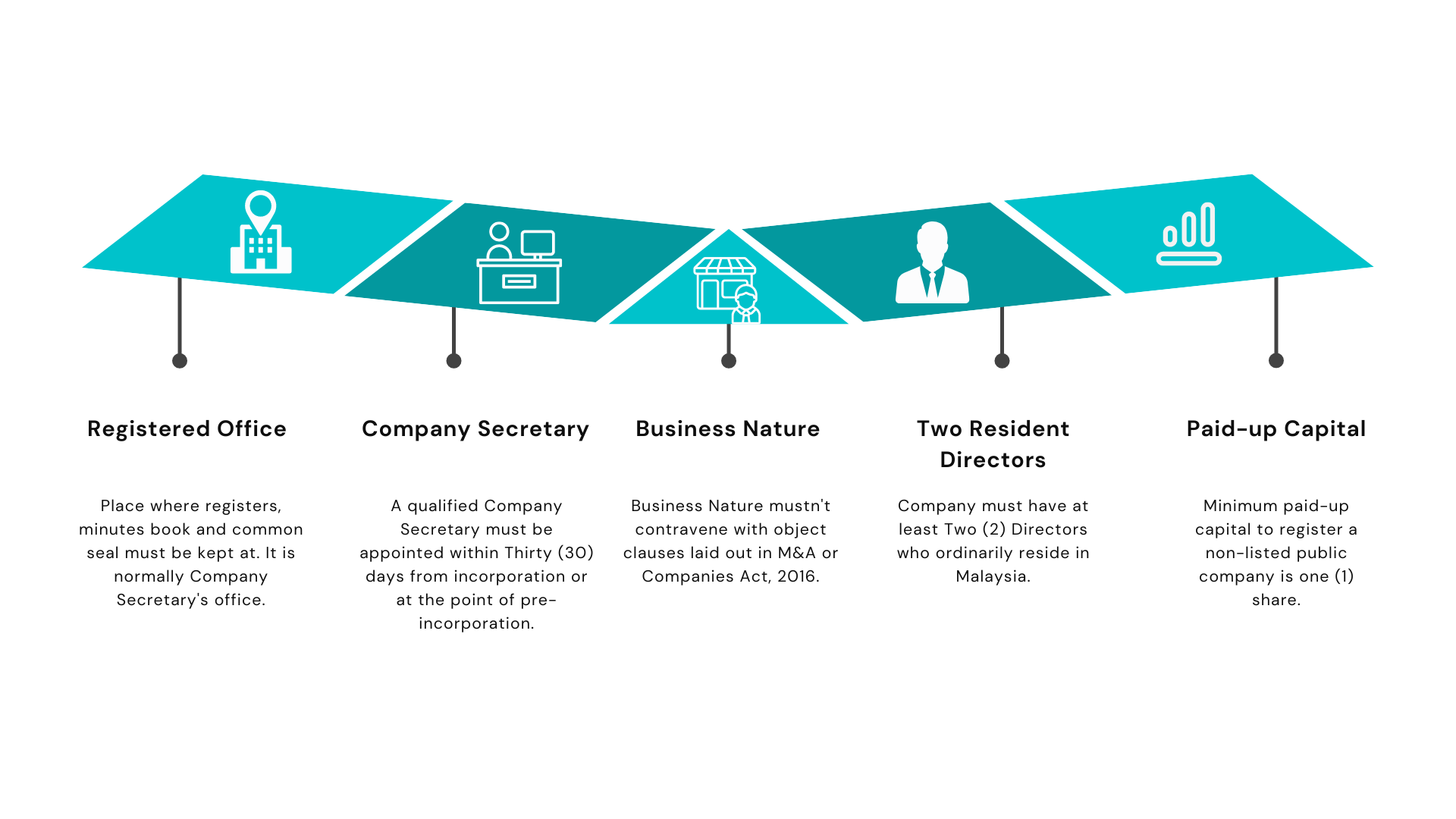
What you need to set up a Public Company?
When can a Public Company commence business?
1. A Public Company with share capital which has not issued a prospectus inviting the public to subscribe for its shares or has not issued a prospectus under the Capital Markets and Services Act 2007, shall not commence any business or exercise any borrowing power until:-
- A Statement in lieu of prospectus which complies with the Companies Act, 2016 has been lodged with the registrar.
- A Statutory declaration verifying the requirements under the relevant paragraphs in Companies Act, 2016 have been complied with.
2. The Company shall become entitled to commence business or exercise any borrowing powers after lodgement of the statutory declaration with the registrar.
Annual Obligations of Public Company
The company must submit its annual return within 30 days from each anniversary of its incorporation date.
2. Annual General Meeting (AGM)
Every public company is required to hold the first AGM within eighteen (18) months from the date of incorporation. The subsequent AGM must be hold within six (6) months from the financial year end and not more than fifteen (15) months from the last preceding AGM (whichever is earlier).
3. Financial Statements and Reports
The company’s financial statements and related reports must be circulated to shareholders and auditors at least twenty-one (21) days before the date of AGM. The financial statement must be lodged with CCM via MBRS portal within 30 days from the date of AGM.
4. Beneficial Ownership Reporting
The company is required to submit the latest beneficial ownership details together with its annual return, ensuring any updates are filed beforehand.
5. Annual Tax Return
Form C & R must be filed within seven months following the end of the financial year.
6. Form E
Employers must file Form E by 31 March each calendar year, declaring employee information – even if company has not hired employees.
A Company Limited by Guarantee (abbreviated as CLBG) is a public company incorporated with the principal liability of its members limited by the constitution to such amount as the members undertake to contribute to the assets of the company if the company is wound up.
A CLBG can only be formed for the following objects:
- providing recreation or amusement;
- promoting commerce and industry;
- promoting art;
- promoting science;
- promoting religion;
- promoting charity;
- promoting pension or superannuation schemes; or
- promoting any other objects useful for the community or country, such as environment, health, education, research, social, and sports.
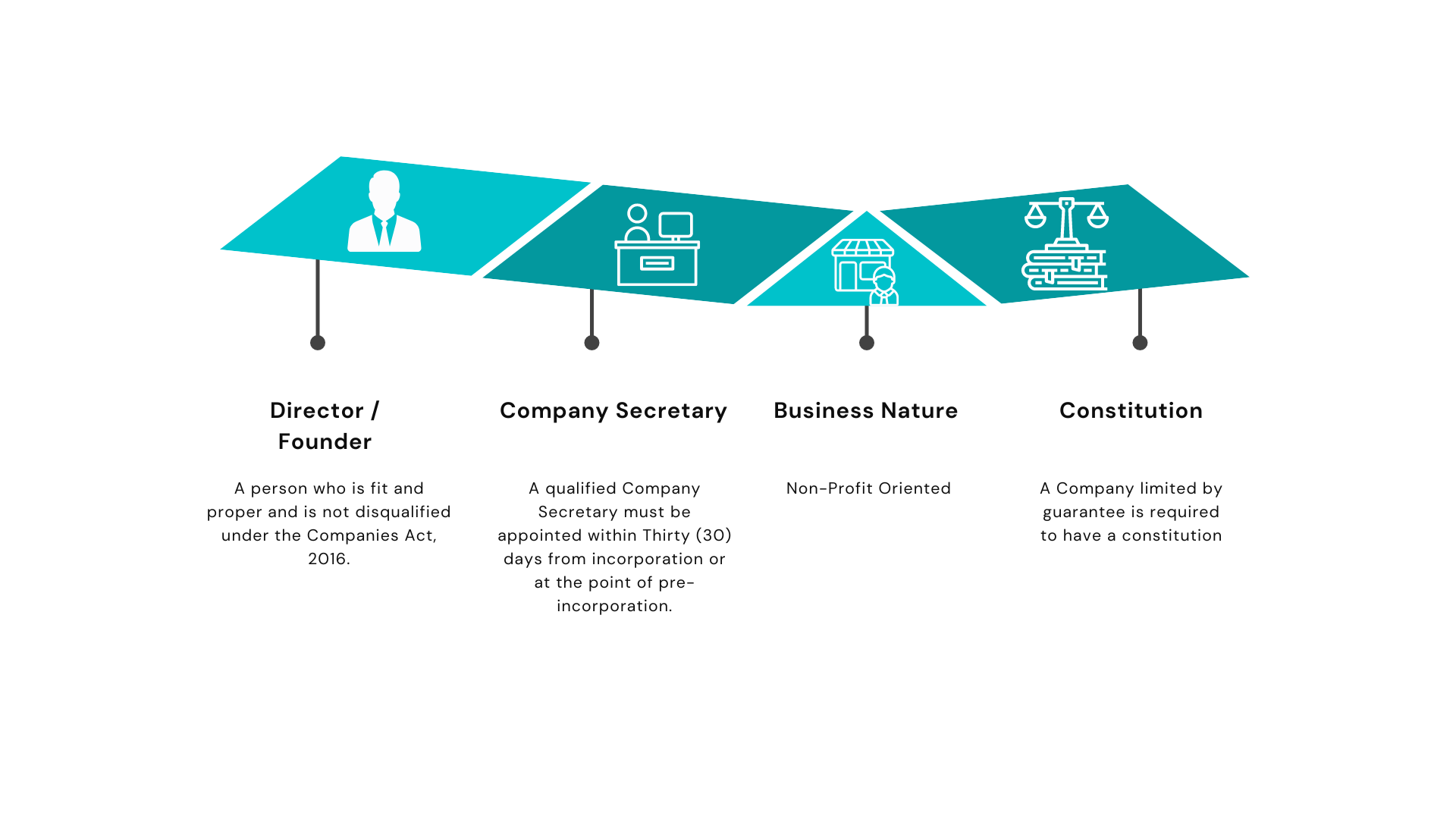
Essential elements to form a CLBG
A Foreign Company (also known as Branch Office) is defined under the Companies Act 2016 as:
(a) A company, corporation, society, association or other body incorporated outside Malaysia; or
(b) An unincorporated society, association or other body which under the law of its place of origin may sue or be sued, or hold property in the name of the secretary or other officer of the body or association duly appointed for that purpose and which does not have its head office or principal place of business in Malaysia.
A Foreign Company may carry on business in Malaysia either by:
(a) Incorporate as a local Company; or
(b) Register the foreign Company.
Registration process for a Foreign Company
1. Name Search and Reservation
An application is submitted to SSM to verify the availability of the foreign company’s legal name. The foreign company name which is to be registered in Malaysia should be the same as the name registered in its country of origin. O
2. Preparation of Incorporation Documents
Prepare and certify (notarised/apostilled) the necessary documents, including:
- Certificate of Incorporation of Parent Company
- Constitution/Memorandum & Articles of Parent Company
- Latest company information
- List of directors and shareholders
- Latest audited financial statements (if required)
- Memorandum of appointment and statutory declaration for the local authorised agent
- Passport copies of directors and authorised agent
- Translated versions of any non‑English documents
3. Appoint a Local Authorised Agent
The foreign company must appoint at least one authorised agent resident in Malaysia to accept notices and represent the foreign company.
4. Application submission to SSM
The signed incorporation documents, together with the prescribed fees, are submitted to SSM for processing. Accuracy and completeness at this stage help to avoid delays in approval.
5. Issuance of Notice of Registration
Upon successful review, SSM issues the Notice of Registration and the Foreign Company may commence operations.
Registration fees of Foreign Company
| Share Capital (RM) |
Fees (RM) |
|---|---|
| Not more than 1 million | 5,000.00 |
| Exceeding 1 million but not exceeding 10 millions | 20,000.00 |
| Exceeding 10 millions but not exceeding 50 millions | 40,000.00 |
| Exceeding 50 millions but not exceeding 100 millions | 60,000.00 |
| Exceeding 100 millions | 70,000.00 |
| Without share capital | 70,000.00 |
Annual Obligations of Foreign Company
1. Annual Return
The company must submit its annual return within 30 days from each anniversary of its registration date.
2. Financial Statements and Reports
Within two (2) months of its annual general meeting, lodge with the registrar a copy of the Financial statements to that company at the place of its incorporation or origin and a duly audited statement showing the foreign company assets used in and liabilities arising out of its operations in Malaysia.
3. Beneficial Ownership Reporting
The company is required to submit the latest beneficial ownership details together with its annual return, ensuring any updates are filed beforehand.
4. Accounting Records
All accounting and other records which sufficiently explain the transactions and financial position of the foreign company arising out of its operations in Malaysia should be kept in Malaysia.
5. Annual Tax Return
It is compulsory for the foreign company to file tax return with LHDN.
6. Form E
Form E is a declaration report submitted by employer to inform LHDN on the number of employees and the list of employee’s income details not later than 31 March of every calendar year.
Registration process of LLP
1. Reserve the LLP name
Check and reserve the preferred LLP name through MyLLP.
2. Preparation of Incorporation Documents
Prepare the necessary documents, including:
- Proposed business activities
- Details of at least two partners
- Information on the appointed Compliance Officer (must be a Malaysian resident)
3. Appoint a Compliance Officer
Every LLP must appoint at least one Compliance Officer responsible for ensuring statutory compliance. This person must be a Malaysian citizen or permanent resident in Malaysia.
4. Submit the LLP registration application
Complete and submit the registration through MyLLP with prescribed registration fees.
5. Receive Certificate of Registration
Once SSM approves the application, the LLP will receive its Certificate of Registration.
Comparison of Limited Liability Parnertship & Private Company
|
Limited Liabilities Partnership |
Private Company |
|
|
|
|
|
|
|
|
|
|
|
|
|
|
|
|
Annual Obligations of LLP
1. Annual Declaration
Every Limited Liability Partnership shall lodge annual declaration annually within 90 days from the end of the financial year. The first annual declaration shall be lodged not later than 18 months from the date of the registration.
2. Financial Statements
LLP is required to prepare complete accounting records containing the profit and loss account, balance sheet and explanatory notes to the accounts for income tax purpose.
There is no mandatory auditing requirement for a LLP.
3. Beneficial Ownership Reporting
An LLP is required to submit the latest beneficial ownership details together with its annual declaration, ensuring any updates are filed beforehand.
There are three primary methods to close a business in Malaysia, depending on the company type and financial situation:
Striking Off
A fast, low-cost option for dormant or inactive companies with no assets, liabilities, or outstanding statutory obligations. It is suitable for the Company that has ceased operations, has no debts and is not involved in legal proceeds.
Quick checklist
- Close the Company’s bank account.
- Terminate the EPF account.
- Terminate the SOCSO account, if applicable.
- Close the Company’s tax file with LHDN.
- Settle any outstanding penalties of compounds imposed by SSM.
- Ensure the Company has no unsatisfied charges registered with SSM.
Winding Up (Liquidation)
It applies when strike-off conditions are not met (e.g., company has assets, liabilities, debts, creditors).
a) Members’ Voluntary Winding Up – Used when company is solvent.
LLP Closure
- LLP has ceased operations
- No liabilities or debts
- No ongoing legal issues
- All tax obligations fully settled
Simplified Summary Table — All Closure Methods in Malaysia
| Method | Suitable For | Involves Liquidator? | Court Involved? | Speed |
|---|---|---|---|---|
| Strike-Off | Dormant, debt-free Sdn Bhd | ❌ | ❌ | Fast (3–12 months) |
| MVL | Solvent companies | ✔️ | ❌ | Medium (6–12 months) |
| CVL | Insolvent companies | ✔️ | ❌ | Slow (12–24 months) |
| Compulsory Winding Up | Insolvent or disputed companies | ✔️ | ✔️ | Slowest (1–3 years) |
| LLP Closure | Dormant LLPs | ❌ | ❌ | Medium (3–6 months) |
Follow us

